
Anyone selling online who starts using AI-generated images runs into the same question: are these images mine, can I put them in the store and in my advertising, and am I taking a risk if I do? The answer depends on three separate things, which often get mixed up: the license of the service that generated the image, copyright in the image, and the transparency obligations of the AI Act, the European regulation on artificial intelligence. This article takes them one at a time, with the rules that apply on Seedboard.
The license: what the service that generated the image lets you do
The first thing to check is the service contract. Every platform that generates images sets out in its terms what the user may do with them, and the rules vary a great deal from one service to another: some allow commercial use only on paid plans, others rule it out entirely, others again require you to credit the service. An image generated on a free plan that does not include commercial use cannot be used to sell, even though technically nothing stops you.
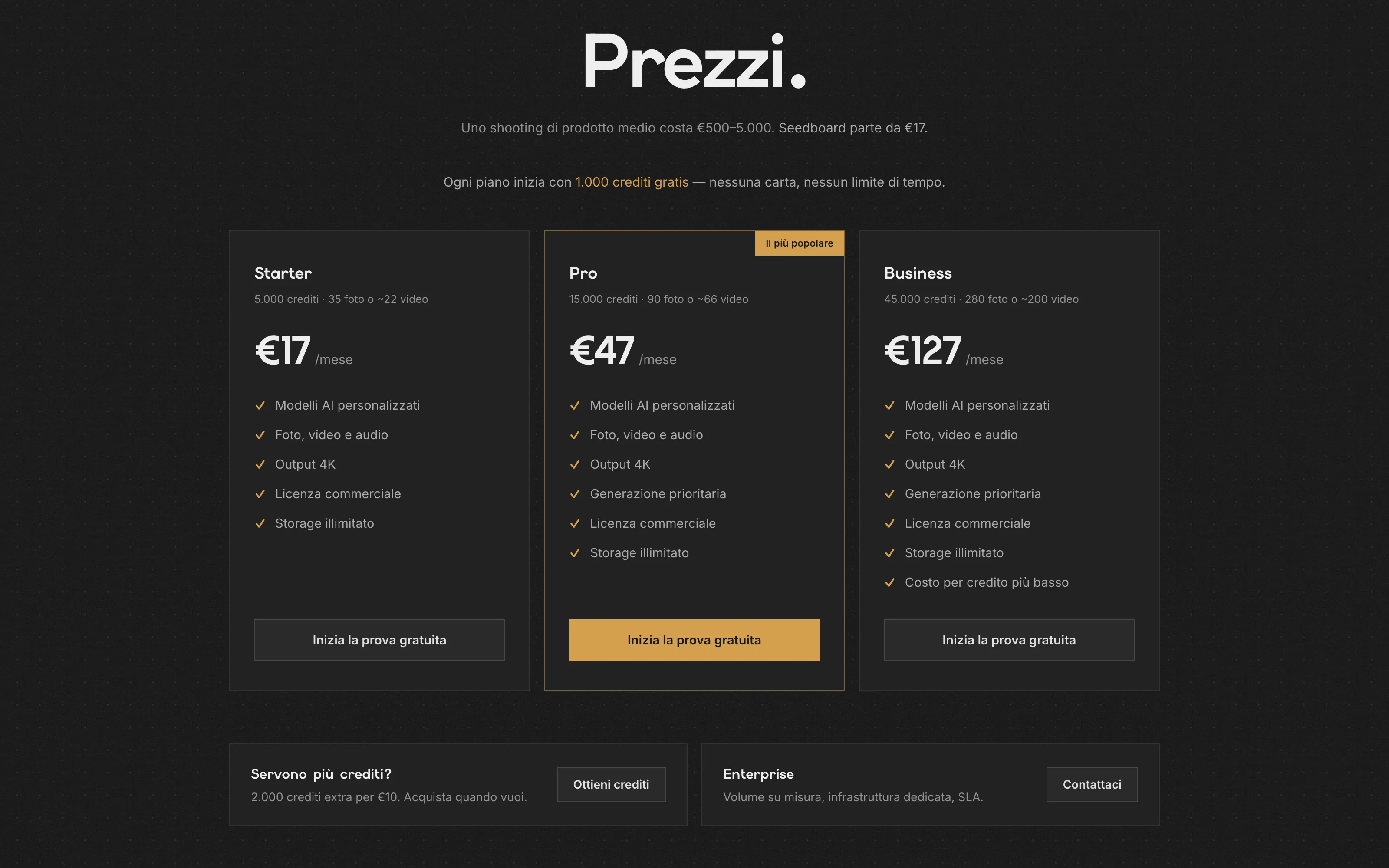
On Seedboard the rule is this. With a paid plan or a credit pack you get a perpetual, worldwide license to use everything you generate, including commercially: you can publish the images in your online store, in advertising and on social media, edit them and distribute them, with no time limit and without having to credit Seedboard. Content generated with the free trial is for personal evaluation instead, to work out whether the service suits you before paying.
Copyright: why you do not own an AI image the way you own a photo you took
The second question is different from the first, and it causes more confusion. Having the license to use an image does not make you its author in the eyes of the law. In Italy, and in the European Union generally, copyright protects works that are the author's own intellectual creation, which requires a human contribution: Italian law 132/2025, at article 25, writes that requirement into the copyright act for works made with the help of artificial intelligence. An image generated entirely by artificial intelligence, with no creative human contribution, is generally not protected; where a person's creative choices shape the result, protection may apply, case by case. How this is handled differs from country to country, so it is worth checking the rule where you publish.
For anyone selling, this has one practical consequence, which Seedboard states openly in its terms: images generated entirely by artificial intelligence, without a creative human contribution, are not covered by exclusive copyright, and similar results could be produced for other users. You can use them freely to sell, but you cannot stop others from generating images that resemble yours. For a catalog or a campaign that is usually not a problem; it becomes one only if the image has to work as a trademark or as a distinctive asset to defend, and in that case it is worth asking a lawyer.
People in the images: AI models and real people
The most delicate point concerns images with a person in them. An AI model, a character generated by artificial intelligence, does not exist in reality and therefore has no image rights to assign; it is one of the reasons brands use one instead of a real model. The problem arises when the generated image reproduces a real person: in that case that person's rights apply, exactly as they would for a photograph.
That is why Seedboard, when it creates a model from a photograph, takes its features to build a character that looks similar but never copies the real person, and refuses photographs of minors and of recognizable public figures. The model that comes out is a new, distinct character, and the images of it can be used to sell without collecting releases. How a model is created is explained in the article on creating an AI fashion model for your brand.
The AI Act and transparency: saying that the image is generated
The third question concerns the AI Act, the European regulation on artificial intelligence (EU Regulation 2024/1689), which sets transparency obligations on generated content. Article 50(4) provides that anyone publishing AI-generated content that realistically depicts existing people, places or events, what the regulation calls deep fakes, must disclose that it was generated, and services producing such content have to mark it in a machine-readable way. That article has applied since 2 August 2026. For systems already on the market when it came in, the Commission's guidelines on Article 50 (C(2026) 5054, point 153) set 2 December 2026 as the date by which the marking has to be in place. So the obligation is live: check your own case before publishing, and make sure you have a way to signal where the images come from.
On this point, who is behind the service matters too. Seedboard is an Italian platform, built by an Italian company, and the European rules are the framework we work in every day. That is why we have built them into the platform: images generated on Seedboard carry information in their metadata declaring their origin, and we update the platform as new European provisions come into force. Anyone selling in Europe has an Italian counterpart, easy to reach and subject to the same laws.
The product photos you upload stay yours
One last common worry concerns the photographs users upload in order to generate images, the photos of their own products for instance, or the face a model starts from. On Seedboard those photographs are not used to train artificial intelligence models, and are passed to providers only to carry out the generation request. The full rules are in the frequently asked questions and on the pricing page.
This describes the service and is not legal advice on the use of images in a specific case. The subject moves quickly and it is worth checking the rules again at the time of publishing.
Frequently asked questions
Can AI-generated images be used in an online store?
Yes, if the service that generated them allows it. On Seedboard commercial use is included in the paid plans and in the credit packs, which grant a perpetual, worldwide license to everything that is generated. Content from the free trial is for personal evaluation instead.
Are AI-generated images protected by copyright?
In Italy, and in the European Union generally, copyright protects works that are the author's own intellectual creation, which requires a human contribution. An image generated entirely by artificial intelligence, with no creative human contribution, is generally not protected, which is also why similar results could be produced for other users. That does not stop you from using it to sell, but it does not let you stop others from using similar ones. The rule differs from country to country, so it is worth checking the one that applies to you.
Does the AI Act require you to declare that an image was created with AI?
The AI Act, the European regulation on artificial intelligence, sets transparency obligations on generated content, in particular on deep fakes, meaning content that realistically depicts existing people, places or events. The rules apply in stages, so it is worth checking the date and your specific case before publishing.
Can I create an image of a real person with AI, a customer or a testimonial for instance?
Not on Seedboard. Starting from a photograph, the system builds a character that looks similar but never copies the real person, and photographs of minors and of recognizable public figures are refused.
Are the photos of my products used to train the AI?
No. Photographs uploaded to Seedboard are not used to train artificial intelligence models, and are passed to providers only to carry out the generation request.